
The Next Stage of Hospital Digital Transformation
Hospitals Have Successfully Digitized Operations. Now It's Time To Govern Digital Work.
Smartphones have become operational tools supporting patient care, communication, maintenance, and administration. Digital Workforce Governance helps ensure technology remains aligned with patient care, workforce productivity, and operational excellence — while respecting employee privacy.
Quick Summary
Hospitals have transformed clinical operations through EMR, HIS, mobile applications, QR-code workflows, and paperless processes. Digital Workforce Governance is the next stage: aligning internet access on those same devices with shift, role, and department — not blocking or monitoring, governing.
The Evolution of Healthcare
Hospitals have moved through distinct stages of digital maturity — each one building operational capability the last stage didn't have.
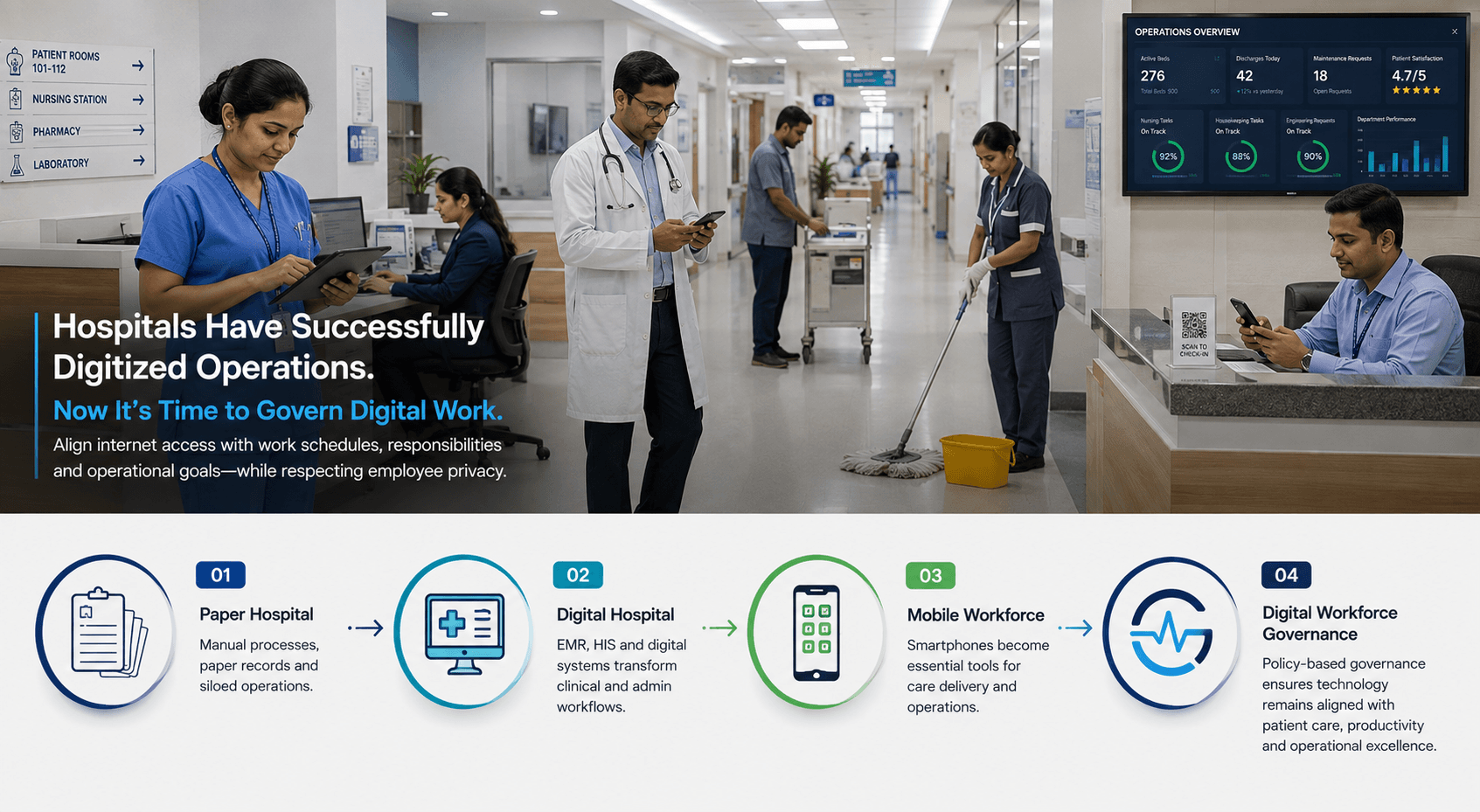
The Smartphone Paradox
The same device that runs clinical workflows is the device that reaches everything else.
Smartphones Enable
- Electronic Medical Records (EMR)
- Hospital Information Systems (HIS)
- QR-code scanning
- Barcode medication verification
- Digital nursing checklists
- Maintenance requests
- Internal communication
Smartphones Also Enable
- Social media
- Entertainment
- Online gaming
- Video streaming
- Shopping
- Personal browsing
The issue isn't smartphones. The issue is governance.
The Digital Governance Gap
Hospitals invested heavily in digital transformation — EMR, HIS, QR-code workflows, and mobile applications now run daily operations. But technology adoption has advanced faster than operational governance: hospitals already govern infection control, medication protocols, patient safety procedures, and access control with structured discipline, yet internet access on the same devices that run those systems has been left to chance.
Digital Workforce Governance closes that gap — applying the same operational discipline hospitals already trust to digital work.
Operational Scenarios
Real operational moments, not hypothetical risk scenarios — every hospital leadership team will recognize these.
Busy Nursing Station
Peak-hour coordination, without added supervision.
Read the scenario →Housekeeping & Patient Experience
Response consistency, without new supervision.
Read the scenario →Engineering & Maintenance
Consistent response across concurrent work orders.
Read the scenario →Registration & Front Office
Steadier service during the busiest hours.
Read the scenario →Ward Support Staff
Smooth coordination, unrestricted personal time.
Read the scenario →Pharmacy
Consistent dispensing turnaround, not a safety claim.
Read the scenario →Digital Workforce Governance Framework
Technology follows organizational policy — not the other way around.
What Makes Cyber Pulse Different
Not a feature comparison — a different discipline.
| Traditional MDM | Digital Workforce Governance | |
|---|---|---|
| Device ownership | Corporate-owned devices | BYOD — personal devices, no enrollment |
| Approach | Device management | Operational governance |
| Control mechanism | Application control | Shift, department, role, and break-based internet policies |
| Primary lens | Security | Privacy-first |
Privacy First
Digital Workforce Governance is not employee surveillance. Cyber Pulse does not:
Employee privacy remains protected — not as a policy promise, but as an architectural constraint. The platform governs internet access; it is not built to observe anything beyond that.
Who Benefits
Digital Workforce Governance touches operations, technology, people, and cost — it matters differently to each seat at the table.
CEO
Operational excellence.
CIO
Governance without a new MDM burden.
CHRO
Fair, transparent digital policies.
COO
Better operational discipline.
Nursing Director
Reduced workflow interruptions.
Facilities Head
Improved service coordination.
Hospital Digital Maturity Model
Where does your hospital sit today?
Paper
Manual records, printed charts, and physical registers. No digital operations.
Digitized
EMR, HIS, and digital checklists replace paper — individual systems, digitized in isolation.
Connected
Systems integrate. QR workflows, barcode verification, and mobile apps connect departments to each other.
Mobile Workforce
Smartphones become operational tools — but internet access on those same devices remains ungoverned.
Digital Workforce Governance
Internet access aligns automatically with shift, role, and department — policy-driven, privacy-first, enforced without manual supervision.
Frequently Asked Questions
What is Digital Workforce Governance?
Digital Workforce Governance is the practice of automatically governing enterprise internet access based on business policies, work schedules, and operational requirements — while preserving employee privacy. It replaces manually written, manually enforced acceptable-use policy with automatic, schedule-aware enforcement.
Why do hospitals need Digital Workforce Governance?
Hospitals have digitized clinical operations — EMR, HIS, QR-code workflows — but internet access on the same devices during paid shifts has remained ungoverned. Digital Workforce Governance closes that gap by aligning access with shift, role, and department, the same way hospitals already govern medication protocols and access control.
How is Digital Workforce Governance different from MDM?
Mobile Device Management manages the device itself and requires enrollment and ownership rights suited to corporate-owned hardware. Digital Workforce Governance governs internet access only, requires no enrollment, and is built for BYOD — the device stays entirely under the worker's control outside governed hours.
How does Digital Workforce Governance improve productivity?
By reducing time lost to non-work digital activity during paid shifts, consistently across every shift, department, and site — without relying on a supervisor to notice and intervene.
Does Digital Workforce Governance monitor employees?
No. It is not employee surveillance. It does not inspect personal messages, calls, photos, emails, or files, on any device, at any time — it governs internet access only.
How does Digital Workforce Governance protect privacy?
Privacy is architectural, not a setting. The platform is built to be incapable of observing message content, call logs, photos, or files — enforcement happens at the DNS layer, based on policy, without ever seeing what a device's traffic would have carried.
Beyond Hospital Digitization
The Next Stage of Digital Transformation
Download the executive whitepaper on Digital Workforce Governance for Modern Hospitals — written for CEO, CIO, CHRO, and CFO.